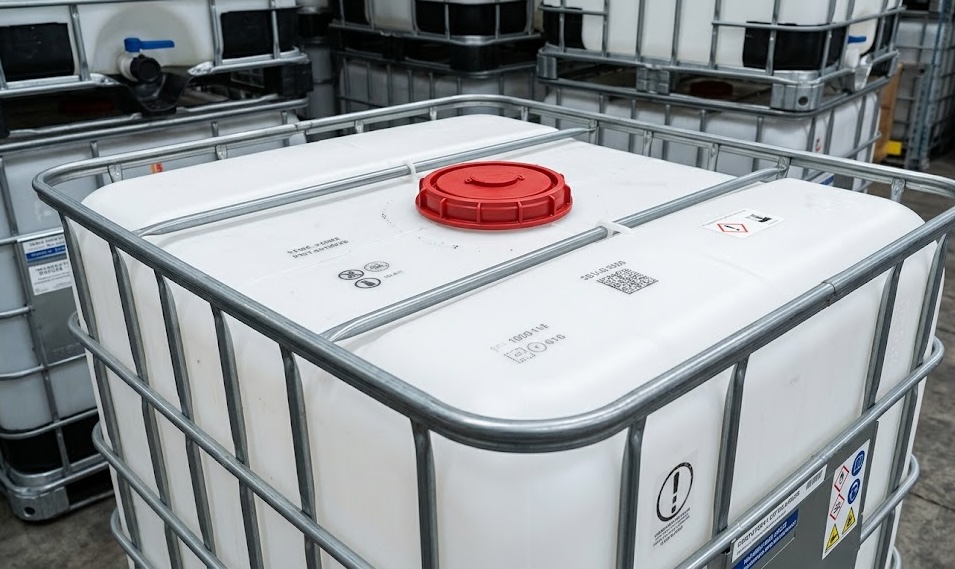
The Anatomy of Every Gallon
Intermediate Bulk Containers (IBCs) come in standardized sizes designed for efficient storage and transport. This comprehensive guide covers everything you need to know about IBC tote dimensions, capacities, and specifications — from standard 275-gallon units to oversized 550-gallon doubles and specialty slim-line models.
Whether you're planning storage space, calculating shipping logistics, or choosing between sizes, this guide has the data you need. We include weight calculations for common liquids, pallet compatibility matrices, forklift specifications, and stacking diagrams to help you plan your operation down to the square inch.
All dimensions listed conform to ISO 3394 pallet standards and UN transport packaging regulations (49 CFR 178.705). Measurements have been verified against Mauser, Schutz, and Greif manufacturer specifications — the three largest composite IBC producers globally, representing over 65% of all IBCs manufactured worldwide.
Standard IBC Dimensions
The table below covers the four most common IBC sizes in the North American market. The 275-gallon model accounts for roughly 70% of all composite IBCs in circulation, followed by the 330-gallon at about 20%. The 120-gallon compact and 550-gallon double serve niche applications where standard sizing is impractical.
| Specification | 120 Gallon (Compact) | 275 Gallon (Standard) | 330 Gallon (Large) | 550 Gallon (Double) |
|---|---|---|---|---|
| Capacity (US Gal) | 120 | 275 | 330 | 550 |
| Capacity (Liters) | 454 | 1,040 | 1,249 | 2,082 |
| Capacity (Imperial Gal) | 100 | 229 | 275 | 458 |
| Length | 40" (1,016 mm) | 48" (1,220 mm) | 48" (1,220 mm) | 48" (1,220 mm) |
| Width | 32" (813 mm) | 40" (1,016 mm) | 40" (1,016 mm) | 48" (1,220 mm) |
| Height (Overall) | 38" (965 mm) | 46" (1,168 mm) | 53" (1,346 mm) | 53" (1,346 mm) |
| Height (Bottle Only) | 32" (813 mm) | 40" (1,016 mm) | 47" (1,194 mm) | 47" (1,194 mm) |
| Pallet Height | 6" (152 mm) | 6" (152 mm) | 6" (152 mm) | 6" (152 mm) |
| Floor Space (sq ft) | 8.9 | 13.3 | 13.3 | 16.0 |
| Empty Weight | ~85 lbs (39 kg) | ~130 lbs (59 kg) | ~145 lbs (66 kg) | ~200 lbs (91 kg) |
| Full Weight (water) | ~1,086 lbs (493 kg) | ~2,425 lbs (1,100 kg) | ~2,897 lbs (1,314 kg) | ~4,790 lbs (2,173 kg) |
| Max Gross Mass | 1,320 lbs (600 kg) | 2,645 lbs (1,200 kg) | 3,086 lbs (1,400 kg) | 5,070 lbs (2,300 kg) |
| Pallet Type | HDPE | Steel or HDPE | Steel or HDPE | Steel |
| Outlet Valve | 2" (50mm) butterfly | 2" (50mm) butterfly | 2" (50mm) butterfly | 2" (50mm) butterfly |
| Valve Height from Floor | 7.5" (190 mm) | 7.5" (190 mm) | 7.5" (190 mm) | 7.5" (190 mm) |
| Fill Opening | 6" (150mm) | 6" (150mm) | 6" (150mm) | 6" (150mm) |
| Wall Thickness (Bottle) | 2.0 mm | 2.0–3.0 mm | 2.5–3.5 mm | 3.0–4.0 mm |
| Cage Wire Diameter | 4 mm | 5 mm | 5 mm | 6 mm |
| UN Designation | 31HA1 | 31HA1 | 31HA1 | 31HA1 |
Weight Calculations for Common Liquids
The full weight of an IBC depends heavily on what you're storing. Water weighs 8.34 lbs per gallon, but many industrial liquids are significantly heavier or lighter. Knowing the filled weight is critical for forklift capacity planning, truck loading, floor load calculations, and stacking safety. Always verify that your loaded IBC does not exceed the maximum gross mass stamped on the UN marking plate.
The table below shows approximate full weights for a standard 275-gallon IBC (tare weight ~130 lbs) and a 330-gallon IBC (tare weight ~145 lbs) filled with common industrial liquids. Specific gravity (SG) values are at 68°F (20°C).
| Liquid | Specific Gravity | lbs/gallon | 275-Gal Full Weight | 330-Gal Full Weight |
|---|---|---|---|---|
| Water | 1.00 | 8.34 | 2,424 lbs | 2,897 lbs |
| Vegetable Oil | 0.92 | 7.67 | 2,239 lbs | 2,676 lbs |
| Corn Syrup | 1.38 | 11.51 | 3,295 lbs | 3,943 lbs |
| Glycerin | 1.26 | 10.51 | 3,020 lbs | 3,613 lbs |
| Ethanol (95%) | 0.81 | 6.76 | 1,989 lbs | 2,376 lbs |
| Diesel Fuel | 0.85 | 7.09 | 2,080 lbs | 2,485 lbs |
| Hydrochloric Acid (30%) | 1.15 | 9.59 | 2,767 lbs | 3,310 lbs |
| Liquid Soap / Detergent | 1.05 | 8.76 | 2,539 lbs | 3,036 lbs |
| Latex Paint | 1.30 | 10.84 | 3,111 lbs | 3,722 lbs |
| Phosphoric Acid (75%) | 1.57 | 13.09 | 3,730 lbs | 4,465 lbs |
| Isopropyl Alcohol | 0.79 | 6.59 | 1,942 lbs | 2,320 lbs |
| Molasses | 1.42 | 11.84 | 3,386 lbs | 4,052 lbs |
Weight Calculation Formula
To calculate the full weight for any liquid not listed above:
For example, a 275-gallon IBC filled with a liquid at SG 1.20: 130 + (275 × 8.34 × 1.20) = 130 + 2,752 = 2,882 lbs. Always confirm the result does not exceed the maximum gross mass on the UN plate (typically 2,645 lbs for a standard 275-gallon unit). If your product exceeds this limit, you must under-fill accordingly or use a higher-rated container.
Understanding IBC Components
Every composite IBC consists of four primary components. Understanding the detailed specifications of each component helps when ordering replacement parts, assessing condition, and ensuring compatibility between different manufacturers.
The Bottle (Inner Container)
Made from high-density polyethylene (HDPE), the bottle is the primary liquid container. HDPE is chosen for its chemical resistance, UV stability, and food-safe properties. The wall thickness is typically 2-3mm for 275-gallon models and 3-4mm for larger sizes, providing excellent durability while remaining lightweight. Standard color is natural/translucent white, allowing visual level checking.
- Material: Virgin or recycled HDPE (resin code #2)
- Melting point: 266°F (130°C); recommended max temp: 140°F (60°C)
- UV resistance: 12-24 months outdoor exposure before degradation begins
- Cold resistance: Rated to -40°F (-40°C) when empty
- Bottle weight (275 gal): 42-48 lbs depending on manufacturer
- FDA 21 CFR 177.1520 compliant for food contact when new
The Cage (Steel Frame)
The galvanized steel cage provides structural support and protection for the bottle. It's designed to distribute the weight evenly when stacked and to protect against puncture. Standard cages feature a grid pattern that allows visual inspection of the bottle contents. Cages are typically zinc-coated for corrosion resistance.
- Material: Galvanized mild steel (zinc coating 40-60 g/m²)
- Wire diameter: 4-6 mm depending on size and manufacturer
- Grid spacing: 50mm × 50mm (standard) or 100mm × 100mm (open mesh)
- Cage weight (275 gal): 55-65 lbs
- Stacking load capacity: 4,000-6,600 lbs (varies by manufacturer)
- Top frame designed as nesting surface for stacked unit above
The Pallet (Base)
IBC pallets come in two varieties: steel (tubular or formed) and HDPE plastic. Steel pallets are more durable and better for stacking but heavier. Plastic pallets are lighter and won't rust. Both types are designed for standard forklift access from all four sides (4-way entry).
- Steel pallet weight: 35-45 lbs; HDPE pallet weight: 20-28 lbs
- Fork pocket opening: 3.5" H × 9" W (standard) — fits all common forks
- Fork pocket centers: 24.5" apart on the 40" side; 30" on the 48" side
- Steel pallet types: tubular (most common), channel formed, hybrid
- Integrated drain: Some pallets include a drain channel for spill containment
- Load rating (dynamic): 2,645 lbs minimum for standard 275-gallon units
The Valve (Discharge)
The standard 2" (50mm) butterfly valve is located at the bottom of the IBC. Butterfly valves provide a full-bore opening for maximum flow rate and easy cleaning. Some IBCs feature ball valves as an alternative. The valve connects to standard camlock fittings for easy plumbing integration.
- Standard thread: 2" NPS (National Pipe Straight) or S60×6 (DIN 61)
- Flow rate (butterfly, full open): ~40 GPM at gravity pressure
- Flow rate (ball, full open): ~50 GPM at gravity pressure
- Gasket material: EPDM (standard), Viton (chemical resistant), Teflon (food-grade)
- Camlock adapter: Type A (male) is the most common IBC-to-hose connection
- Valve height from floor: approximately 7.5" (190 mm) — bucket fits underneath
Fill Cap & Lid Specifications
The fill opening at the top of the IBC is sealed with a threaded cap, typically 6" (150mm) diameter. This opening serves as the primary filling port and also provides access for internal cleaning. Understanding the cap threading is important when ordering replacement caps or adapters.
| Feature | Standard Cap | Vented Cap | Tamper-Evident Cap |
|---|---|---|---|
| Diameter | 6" (150mm) | 6" (150mm) | 6" (150mm) |
| Thread | NPS 150mm or DN 150 | NPS 150mm or DN 150 | NPS 150mm or DN 150 |
| Gasket | EPDM O-ring | EPDM O-ring | EPDM O-ring |
| Pressure Relief | None | Yes (2 PSI relief valve) | None |
| Best Use | General liquids, water | Products that off-gas (solvents, fermentables) | Food-grade, sealed chain-of-custody |
Storage & Stacking
Stacking Guidelines
Standard IBC totes are designed to be stacked when full. However, proper stacking depends on the condition, weight capacity, and alignment of each unit. Stacking errors can lead to catastrophic collapse, causing injuries and product loss. Always follow these guidelines:
- New/Reconditioned: Can be stacked 2-high when full (check manufacturer rating — typically 4,000–6,600 lbs stacking load capacity)
- Used Grade A/B: Stack 2-high only when full with proper alignment — corners of upper pallet must seat squarely onto the cage frame of the lower unit
- Used Grade C: Do not stack when full — cage damage may compromise structural integrity. Stacking a loaded Grade C can exceed the residual strength of deformed cage members
- Empty: Can be stacked 3-4 high regardless of condition. Empty totes weigh only ~130 lbs, well within stacking limits
- Mixed sizes: Never stack different sizes on top of each other — the footprint mismatch creates unstable load distribution
Stacking Diagram Description
When properly stacked, the upper IBC's pallet runners sit inside the cage frame rails of the lower IBC, creating a locked, interlocking structure. Here is how the geometry works:
- Lower Unit: The top frame of the cage has four upright corner posts that extend approximately 1.5" above the top rail. These act as locating pins.
- Upper Unit: The pallet base has channels or pockets that align over the corner posts of the lower cage. This prevents lateral sliding.
- Load Path: Weight transfers through the corners of the pallet, down the corner posts, through the vertical cage tubes, and into the lower pallet and floor.
- Total Stack Height: Two 275-gal IBCs stacked = ~92" (7.67 ft). Two 330-gal IBCs = ~106" (8.83 ft). Ensure your ceiling clearance exceeds these heights plus a 6" safety margin.
- Floor Loading: Two stacked full 275-gal IBCs exert approximately 36.4 PSI on a 13.3 sq ft footprint (4,850 lbs total). Verify your floor is rated for this concentrated load.
Storage Planning Guide
Planning warehouse or yard space for IBC storage requires accounting for the container footprint, aisle space for forklift maneuvering, safety clearances, and stacking configuration. Use the table below to estimate how many IBCs fit in your available space.
| Space Available | 275-Gal (Single High) | 275-Gal (Double High) | Total Gallons (Double) |
|---|---|---|---|
| 10 × 10 ft (100 sq ft) | 4 units | 8 units | 2,200 gal |
| 20 × 20 ft (400 sq ft) | 12 units | 24 units | 6,600 gal |
| 40 × 40 ft (1,600 sq ft) | 48 units | 96 units | 26,400 gal |
| Standard 53' Trailer | 20 units | 40 units | 11,000 gal |
| 20' Shipping Container | 8 units | 16 units | 4,400 gal |
Aisle Space Requirements
The number of IBCs you can fit depends heavily on your aisle configuration. Here are standard aisle width requirements for different equipment:
- Standard Counterbalance Forklift: 12–13 ft aisle width minimum
- Narrow Aisle Forklift: 8–10 ft aisle width
- Pallet Jack (Manual): 6 ft aisle width minimum
- Electric Pallet Jack: 7 ft aisle width minimum
- Fire Code Clearance: 18" minimum between top of stacked IBCs and sprinkler deflectors (NFPA 13)
- Wall Clearance: 3" minimum from walls for air circulation and pest inspection access
Forklift Specifications
Not every forklift can safely handle a full IBC tote. A loaded 275-gallon IBC weighs approximately 2,425 lbs, and a 330-gallon unit tips the scales at nearly 2,900 lbs. When stacking 2-high, you need a machine that can lift that weight to a height of at least 5 feet. Below are the minimum forklift specifications for safe IBC handling.
| Requirement | 275-Gal (Ground Level) | 275-Gal (Stack 2-High) | 330-Gal (Stack 2-High) |
|---|---|---|---|
| Minimum Lift Capacity | 3,000 lbs | 3,000 lbs at 60" height | 3,500 lbs at 66" height |
| Fork Length | 42" minimum (48" ideal) | 42" minimum (48" ideal) | 42" minimum (48" ideal) |
| Fork Width (each) | 4–6" | 4–6" | 4–6" |
| Fork Spacing | 20–30" center to center | 20–30" center to center | 20–30" center to center |
| Maximum Fork Height | 48" sufficient | 72" minimum | 78" minimum |
| Typical Forklift Class | Class I, IV, or V | Class I, IV, or V | Class IV or V |
| Recommended Machine | 5,000 lb cushion tire | 5,000 lb cushion tire | 6,000 lb pneumatic tire |
Pallet Jack Handling
Manual and electric pallet jacks can also move IBC totes on flat, smooth surfaces. However, they cannot stack IBCs — only transport them at ground level. Pallet jack requirements for IBC handling:
- Capacity: Minimum 3,000 lbs (most standard pallet jacks are rated 5,500 lbs)
- Fork Length: 42–48" to fully engage the pallet
- Surface: Smooth concrete or asphalt. Not recommended on gravel, grass, or uneven ground when loaded
- Grade: Avoid slopes greater than 2% when moving a loaded IBC by manual pallet jack
Pallet Compatibility Matrix
IBC pallets are not universally interchangeable between manufacturers. If you need to replace a pallet (called a "rebottling" when the bottle is also replaced), verify compatibility. The table below shows common pallet types and their cross-compatibility with major IBC brands. This matrix covers the most common configurations seen in the North American market.
| Pallet Type | Material | Fits Mauser Cages | Fits Schutz Cages | Fits Greif Cages |
|---|---|---|---|---|
| Mauser Steel Tubular | Galvanized Steel | Yes | No | No |
| Schutz Steel Tubular | Galvanized Steel | No | Yes | Limited |
| Greif Steel Formed | Galvanized Steel | No | Limited | Yes |
| Universal HDPE (Mauser) | HDPE Plastic | Yes | Most models | Most models |
| Schutz HDPE | HDPE Plastic | Most models | Yes | Most models |
| Wooden Pallet (aftermarket) | Pine/Oak | With adapter | With adapter | With adapter |
Important Pallet Notes
- Steel vs. HDPE: Steel pallets add approximately 15-20 lbs more weight but offer 30-50% higher stacking capacity. Choose steel when stacking is required; choose HDPE when corrosion or weight is a concern.
- GMA Compatibility: All standard IBC pallets (48" × 40") are compatible with GMA (Grocery Manufacturers Association) pallet dimensions, the most common pallet size in North America.
- EU Pallets: European IBC pallets measure 1200mm × 1000mm (47.2" × 39.4"), which is slightly different from the US standard. These fit most standard forklifts but may not align perfectly with US racking systems.
- Replacement Cost: OEM replacement pallets range from $25-60 for HDPE and $40-90 for steel. Aftermarket options may be cheaper but verify stacking compatibility before purchase.
IBC vs. Alternatives
IBCs are one of several bulk liquid container options. The table below shows how they compare across key metrics. Understanding these trade-offs helps you choose the right container for your specific application, budget, and space constraints.
| Container | Capacity | Footprint | Cost (New) | Best For |
|---|---|---|---|---|
| IBC Tote (275 gal) | 275 gal | 48" × 40" | $250–$400 | Bulk liquid storage, efficient pallet shipping |
| 55-Gal Drum (Poly) | 55 gal | 24" diameter | $60–$100 | Smaller quantities, hazardous materials |
| 55-Gal Drum (Steel) | 55 gal | 24" diameter | $50–$90 | Solvents, flammable liquids, tight-head sealing |
| Poly Tank (Vertical) | 100–2,500 gal | Varies | $150–$2,000+ | Permanent installations, large volumes |
| Stainless Steel IBC | 100–550 gal | 48" × 40" | $2,000–$5,000 | Pharma, high-purity, high-temp applications |
| Flexitank | ~6,000 gal | Container-sized | $150–$300 | Single-use bulk transport in shipping containers |
| 5-Gal Pails | 5 gal | 12" diameter | $3–$8 | Small batches, retail, manual dispensing |
Truck Loading Guide
How Many IBCs Fit on a Truck?
The number of IBCs you can load on a truck depends on the trailer type, weight limits, and whether you stack. Here are standard loading configurations for common trailer types:
| Trailer Type | Interior Dimensions | 275-Gal (Single) | 275-Gal (Stacked) | Weight Limit |
|---|---|---|---|---|
| 53' Dry Van | 53' × 8.5' × 9' | 20 units | 40 units (limited by weight) | ~44,000 lbs payload |
| 48' Flatbed | 48' × 8.5' | 18 units | 36 units (if secured) | ~48,000 lbs payload |
| 26' Box Truck | 26' × 8' × 8' | 10 units | 18–20 units | ~10,000 lbs payload |
| Pickup Truck (Full-Size) | ~6.5' × 5.5' bed | 1 unit (empty only) | N/A | ~1,500 lbs payload |
Note: When loading full IBCs on a 53' trailer, weight limits (not space) typically become the constraint. Twenty full 275-gallon IBCs with water weigh ~48,500 lbs, which exceeds the ~44,000 lb payload limit. In practice, you can load 18 full IBCs (water) or more units with lighter liquids. Always check axle weight distribution.
IBC Grading System
Used IBC totes are graded based on the condition of the bottle, cage, pallet, and valve. Understanding the grading system helps you choose the right tank for your application and budget. Here is the industry-standard grading scale used by most IBC recyclers and resellers:
Grade A — Excellent Condition
Near-new appearance. Minimal cosmetic wear. Bottle is clear/white with no yellowing or staining. Cage is straight with no dents or bent bars. Pallet is fully intact. Valve operates smoothly with no leaks. Gaskets are in good condition.
- Typical age: 0-2 uses
- Suitable for: Food-grade applications, resale, customer-facing uses
- Stacking: Full 2-high stacking approved
Grade B — Good Condition
Some cosmetic wear visible. Bottle may show slight yellowing or minor staining that does not affect structural integrity. Cage may have minor dings but all bars are intact and properly aligned. Pallet is functional. Valve works properly — gaskets may need replacement within 6-12 months.
- Typical age: 2-5 uses
- Suitable for: Non-food chemicals, water storage, agricultural use
- Stacking: 2-high stacking approved with careful alignment
Grade C — Fair / Functional Condition
Visible wear and cosmetic damage. Bottle may be yellowed, stained, or show minor surface scratches. Cage may have bent bars, dents, or weld repairs. Pallet may have minor damage but still functions. Valve may need replacement. Still holds liquid — no cracks or leaks.
- Typical age: 5+ uses
- Suitable for: Non-critical storage, rainwater, waste collection, farm use
- Stacking: Not recommended when full
Grade D — Damaged / Recycling Only
Significant damage to one or more components. Bottle may be cracked, have holes, or be severely deformed. Cage may be heavily bent or have missing sections. Pallet may be broken. Not suitable for liquid storage. Components may be salvageable for parts or recycling.
- Suitable for: Parts salvage, recycling, planter conversions, non-liquid storage
- Stacking: Not recommended at all
Still Have Questions?
Our team can help you choose the right IBC size and grade for your specific application. We stock 275-gallon, 330-gallon, and specialty sizes in all grades, with volume discounts available for orders of 10+ units.